
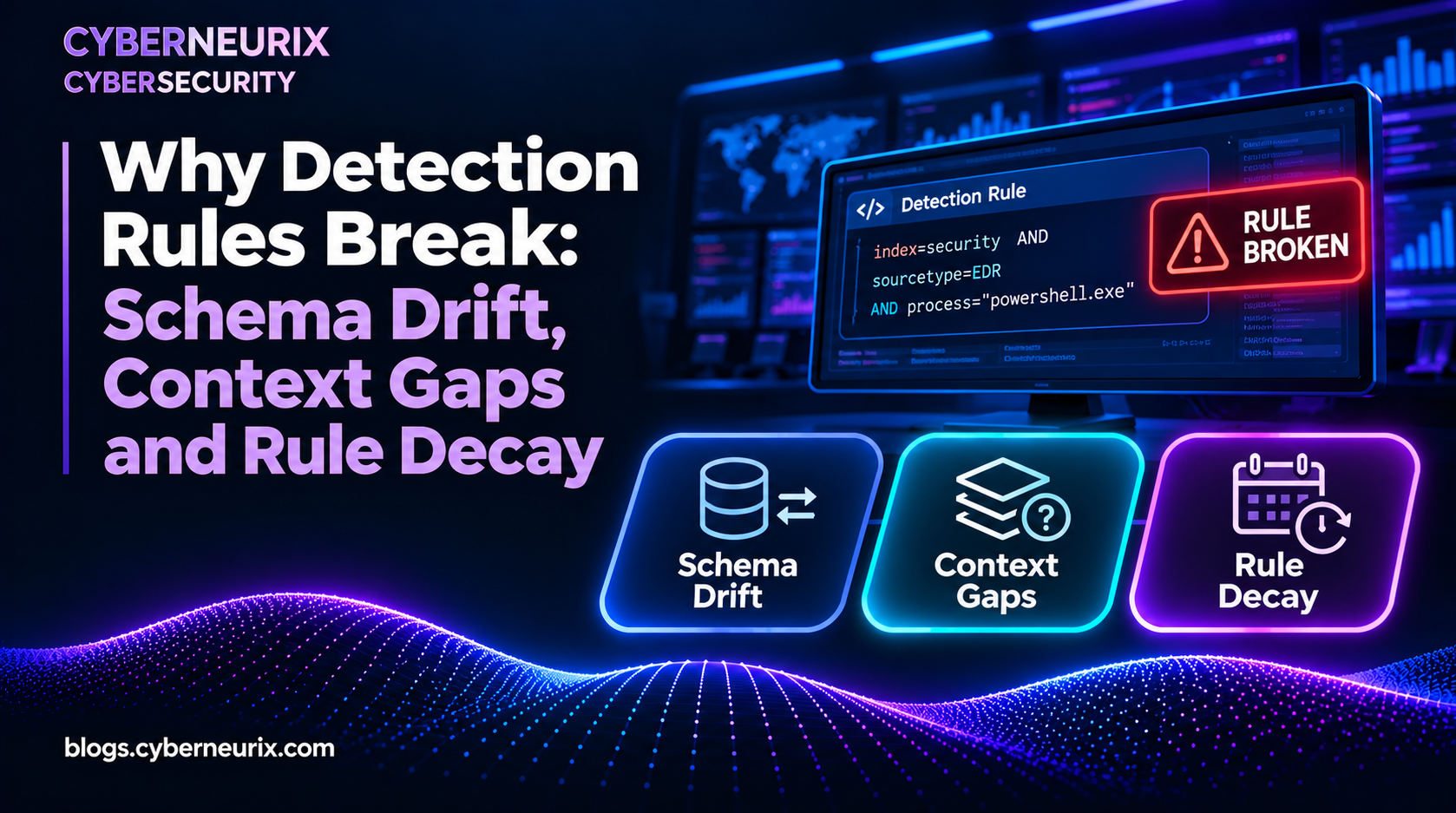
Why Detection Rules Break: Schema Drift, Context Gaps and Rule Decay
Key Takeaways
- A detection rule rarely breaks with an explicit system alert: it fails silently while displaying a green 'Active' status on the SIEM dashboard.
- Over 80% of detection practitioners report struggling to maintain detection logic as threats and corporate environments evolve.
- Schema drift—caused by unannounced cloud, OS, or SaaS log format updates—represents the primary technical root of silent detection failures.
- Over-broad whitelisting and unmanaged suppression rules gradually erode enterprise detection coverage over time.
- Detections must be treated as production software code: complete with version control, unit testing, continuous regression validation, and documented SLOs.
The Silent Death of the Active Detection Rule
When a production database fails, monitoring alerts fire immediately: latency spikes, error codes flood the console, and engineers mobilize within minutes. But when an enterprise SIEM detection rule breaks, there is no error message, no administrative alarm, and no operational crisis. The rule continues to execute on schedule every five minutes; the console shows a green checkmark; and the detection coverage metric remains at 100%.
The failure is completely silent. An upstream cloud provider updated an API, changing the JSON key from source_ip to client_ip. An endpoint engineer updated the Windows Sysmon configuration, altering the Event ID responsible for process injection telemetry. A Tier-1 analyst added a wildcard exclusion to quiet a noisy developer workstation. The detection rule didn't throw an exception—it simply stopped matching real-world events.
This is rule decay: the steady, invisible erosion of detection efficacy across an enterprise. In 2026, detection engineering teams cannot rely on passive faith. They must build automated Quality Assurance (QA) pipelines capable of verifying detection health continuously.
Deep Dive: The Anatomy of Rule Decay & Building Automated Detection QA
1. The Seven Root Mechanisms of Detection Rule Failure
Detection rules break through predictable engineering vectors:
- Upstream Schema Drift: Cloud providers and software vendors frequently modify log schemas during routine updates without versioning notice. A renamed field, a shifted nested JSON hierarchy, or a changed event code immediately breaks hardcoded query logic.
- Telemetry Gaps & Collector Dropouts: A forwarder stops sending events, an audit policy is reverted by Group Policy (GPO), or network firewalls drop syslog traffic during volumetric spikes.
- Timestamp Parsing Anomalies: Changes in timezone formatting (UTC vs local) or clock skew across distributed servers break stateful sequence correlations requiring events to occur within a 5-minute sliding window.
- Context Loss & Identity Mapping Drift: Asset criticality tags disappear from the CMDB, or Active Directory attribute changes prevent the enrichment engine from resolving usernames to administrative roles.
- Over-Broad Exclusion Decay: A quick fix applied six months ago to suppress a backup script (
whitelist process: powershell.exe where user == *) creates a permanent blind spot that attackers subsequently abuse. - Threshold & Baseline Drift: Dynamic enterprise growth causes normal operational traffic to exceed historical statistical thresholds, causing analytics to either flood the queue or permanently suppress alerts.
- Adversary Technique Evolution: Threat actors alter their execution flags, switch living-off-the-land binaries, or leverage unmonitored parent processes to achieve the same objective while evading static string indicators.
The SANS/Anvilogic 2026 State of Detection Engineering survey revealed that 80% of practitioners report falling behind or barely keeping pace with evolving adversary tactics. Measuring coverage by the count of enabled rules creates a dangerous illusion of security.
2. The Seven Root Causes: Quantified Impact
The 2026 SANS/Anvilogic State of Detection Engineering report establishes the quantitative impact of rule decay across 307 surveyed practitioners:
- 66% of false positives originate directly from vendor-provided detection rules, which lack local schema and environment calibration.
- Over 34% of major detection outages are traced back to unannounced upstream log format modifications.
3. Engineering Automated Detection Quality Assurance (QA)
Treating detections as production software requires establishing a complete CI/CD testing contract:
- Detection-as-Code in Git: Every rule, field mapping, and exclusion list is stored as a version-controlled code artifact (YAML/Sigma) with mandatory peer review.
- Continuous Canary Event Injection: Generate synthetic, benign test events every 6 hours that match the precise logic of critical detection rules, verifying that the pipeline successfully delivers an alert to the analyst queue.
- Automated Adversary Emulation (Atomic Red Team): Integrate automated testing frameworks to execute simulated adversary techniques in staging environments following every major SIEM or endpoint agent update.
- Exclusion Lifecycles & Expiry: Enforce hardcoded 90-day expiration dates on all operational exclusion rules, requiring explicit re-validation and sign-off before renewal.
| Failure Mode | Technical Root Mechanism | Silent Warning Sign | Automated Detection QA Fix |
|---|---|---|---|
| Schema Drift | Renamed fields or altered nested JSON hierarchies | Rule query matches zero events over 30 days | Ingest schema validation unit tests in CI/CD |
| Telemetry Drop | Forwarder crash, network drop or reverted GPO | Sharp unexplained volume drop in specific Event ID | Real-time ingestion volume canary threshold alerts |
| Timestamp Skew | Timezone formatting shifts (UTC vs local time) | Sequence correlation rules fail to trigger | Automated ISO 8601 normalisation at stream ingest |
| Exclusion Creep | Over-broad wildcards added during alert fatigue | Sharp decline in alert volume for high-risk assets | Mandatory 90-day expiry & peer review on whitelists |
| Adversary Shift | Adversary alters command-line flags or execution path | Zero detections during red team emulation drills | Continuous Atomic Red Team behavioral validation |
CyberNeurix Unique Angle
"Treat every high-value detection as a production software component with dependencies and a test contract. Its dependencies are data sources, field mappings, time semantics, entity resolution, and expected behavior."
CyberNeurix asserts that an enterprise should never deploy a detection rule it cannot automatically test. When detection teams replace manual GUI rule editing with GitOps pipelines, automated canary testing, and rigorous telemetry contracts, rule decay is detected and remediated within hours rather than during a post-breach forensic investigation.
1. Deploy Synthetic Canary Events: Configure a cron job to generate a known synthetic detection event (e.g., specific canary user failed login) every 6 hours to verify pipeline health.
2. Flag Zero-Match Detections: Automatically audit all active correlation rules that have returned zero matches over the past 45 days for potential schema drift.
3. Enforce GitOps Pull Requests: Lock the SIEM production console from direct rule editing, requiring all rule changes and exclusions to pass through peer-reviewed pull requests.
Conclusion
Detection rules do not fail loudly; they decay quietly as production environments and threat techniques evolve. Building resilient security operations requires abandoning the illusion that an enabled rule guarantees security coverage.
Maintaining high-fidelity detection coverage requires mastering detection engineering and telemetry in 2026. By learning how to onboard logs properly in SIEM platforms, security engineering teams build resilient pipelines that withstand constant environmental change.
Frequently Asked Questions
What is schema drift and how does it break SIEM detection rules?
Schema drift occurs when an upstream log emitter or cloud vendor alters field names, timestamp formats, or event structures during an update, causing correlation rules querying legacy field names to fail silently.
What is 'rule decay' in modern detection engineering?
Rule decay is the gradual, unmonitored loss of detection efficacy over time caused by changing software versions, environmental IT modifications, over-broad false-positive exclusions, and evolving adversary techniques.
How can SOC teams detect silent detection failures before a breach occurs?
Deploy automated synthetic canary events and continuous adversary emulation testing (e.g., Atomic Red Team) in production to verify that critical detection logic actively fires when triggered.
Why are over-broad exclusions dangerous in SIEM correlation tuning?
Exclusions added to suppress a specific noisy workstation or service often use broad wildcard matches that inadvertently suppress malicious lateral movement executed from that same asset.
Comparative Reference: Why Detection Rules Break
| Operational Dimension | Ad-Hoc Manual SIEM Management | Modern Detection-as-Code QA Pipeline |
|---|---|---|
| Rule Storage | Proprietary database inside SIEM console | Version-controlled Git repository (Sigma / YAML) |
| Change Management | Direct GUI editing with zero audit trail | Pull requests with mandatory peer code review |
| Testing Methodology | 'Wait and see' if alerts fire in production | Automated CI/CD regression tests against synthetic logs |
| Schema Drift Detection | Discovered months later during a red-team breach | Detected in minutes via continuous canary execution |
| Exclusion Governance | Permanent unmonitored text whitelist strings | Time-bounded, scoped, audited exclusion files with expiry |
Sources: SANS State of Detection Engineering Survey, Sigma Rules Specification, CyberNeurix Practice
Sources and Further Reading
- SANS 2026 State of Detection Engineering
- Sigma Rules Specification 2.1.0
- Sigma rule creation high-level guide
Explore More on CyberNeurix
Next Evolution: The Strategic Roadmap
As we move further into 2026, the intersection of autonomous response and identity-centric architecture will define the winner's circle in cyber defense. Stay tuned for our upcoming deep-dives into LLM-driven threat modeling and quantum-resistant network perimeters.