
Why SOCs Underperform in Year One: Seven Implementation Mistakes
Key Takeaways
- A SOC is an operational service, not a technology showroom: success depends on decision quality and telemetry hygiene, not the number of screens in a room.
- Attempting to 'monitor everything' on day one leads to uncontrolled ingestion costs, unmanageable alert queues, and total analyst burnout.
- Over 68% of first-year SOC failures trace to uncalibrated default vendor rules and undefined Tier-1 escalation pathways.
- Management must prioritize detection engineering and data pipeline maintenance equally alongside front-line alert triage staffing.
- First-year metrics must measure threat coverage, alert precision, and investigation outcomes rather than raw ticket closure counts.
The Uncomfortable Truth About the Brand-New SOC
The ribbon-cutting ceremony is over. The multi-million-dollar video wall is illuminated with spinning 3D globes and live threat feeds. The enterprise SIEM is ingesting terabytes of daily logs, and a newly recruited team of Tier-1 analysts is seated across three rotating operational shifts. On paper, the enterprise has successfully launched a 24/7 Security Operations Center. Executive leadership feels protected.
Yet within six to nine months, reality inevitably shatters this illusion. The alert queue is hopelessly backlogged with tens of thousands of unreviewed notifications; senior analysts are resigning due to mind-numbing alert fatigue; and during a scheduled red-team adversary emulation exercise, attackers penetrate the active directory core and exfiltrate simulated financial records without triggering a single high-priority escalation.
First-year SOC failures are rarely caused by selecting the wrong SIEM or EDR product. They stem from a series of flawed organizational, architectural, and operational assumptions made during the initial design phase. By understanding the seven classic implementation pitfalls, security leaders can steer their operations toward genuine resilience.
Deep Dive: The Seven Fatal First-Year SOC Implementation Pitfalls
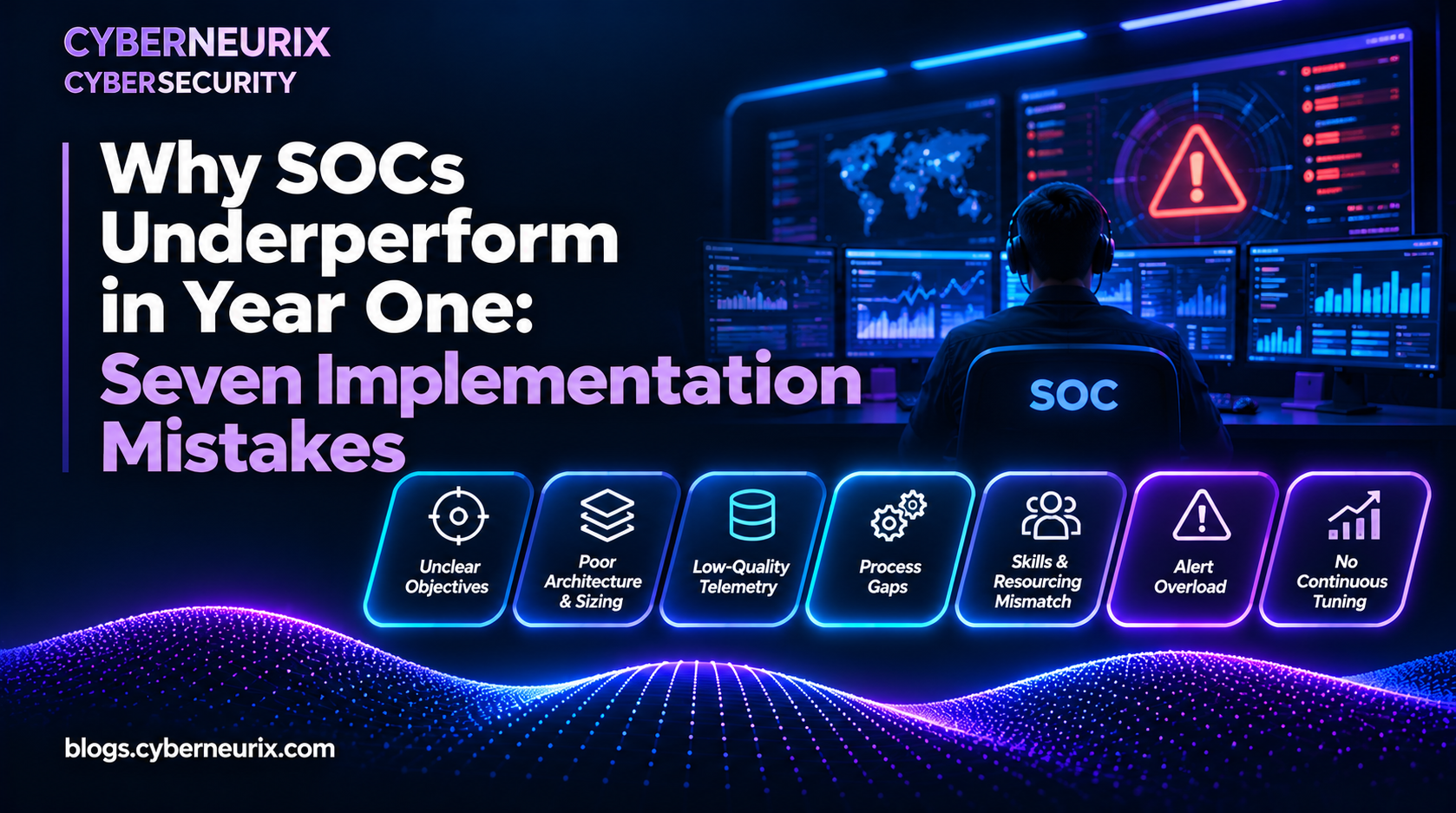
1. The 7 Deadly Sins of First-Year Security Operations
- Undefined Mission & Lack of Risk Priorities: The SOC is tasked with the impossible mandate to 'monitor everything across the enterprise.' Without prioritized threat models tied to critical business assets (crown jewels, customer databases, payment switches), the team drowns in trivial IT noise while high-impact systems remain unmonitored.
- Data Ingestion Before Detection Strategy: Onboarding every log source simply because an API connector exists. Ingestion budgets explode, data lakes fill with unparsed junk telemetry, and nobody has written a single analytic rule querying the newly onboarded data.
- Unreliable Telemetry Contracts: Neglecting basic log engineering: missing timestamps, unparsed user identities, broken forwarders, and unmonitored agent dropouts that silently blind correlation rules.
- Treating Default Vendor Content as Finished Detections: Toggling on 800 pre-packaged SIEM detection rules on day one. The resulting alert blizzard buries the triage queue in thousands of false positives originating from normal administrative scripts.
- Ambiguous Operating Model & Escalation Confusion: Unclear boundaries between Tier-1 (Triage), Tier-2 (Incident Handling), Tier-3 (Threat Hunting), and IT Infrastructure teams. Critical tickets sit in limbo because nobody knows who possesses the authority to isolate a compromised host.
- Tool Sprawl & Disconnected Workflows: Analysts must manually pivot between eight separate consoles—EDR, SIEM, email gateway, firewall, ticketing, threat intelligence, identity provider, and cloud console—wasting 30 minutes on basic copy-pasting for every alert.
- Vanity Activity Metrics Mistaken for Security Outcomes: Management measures performance by 'tickets closed per shift' and 'average call duration.' Analysts quickly learn that spending two hours investigating a subtle lateral movement anomaly ruins their daily performance metrics.
The SANS 2026 SOC Report reveals that only 32% of cybersecurity practitioners feel management provides adequate staffing support. Trying to run a 24/7 Tier-1 shift schedule with fewer than 8–10 dedicated analysts inevitably causes exhaustion, high turnover, and missed breach detections.
2. Survey Evidence: The AI Adoption vs Integration Disconnect
The SANS 2026 SOC Report—surveying 444 practitioners and 69 cyber leaders—exposes why modern operations struggle despite heavy technology investments:
- 79% of SOCs have adopted AI/ML tools, but only 36% have integrated them into a defined operational workflow.
- In year-one implementations, organizations frequently purchase expensive 'AI copilot' add-ons hoping they will replace human analysts, only to find the AI generates automated summaries of false positives without reducing the core investigative burden.
3. The Year-One Remediation Roadmap
To ensure a new SOC succeeds, leadership must enforce structured milestones:
- Months 1–3 (Foundation): Focus exclusively on the top 3 business risks (e.g., Ransomware outbreak, Cloud credential theft, Payment fraud). Onboard only endpoint, identity, and perimeter telemetry required for those specific detections.
- Months 4–6 (Calibration): Institute Detection-as-Code workflows. Quarantine noisy rules, benchmark true-positive yields, and automate Tier-1 enrichment (attaching user and asset details to alerts automatically).
- Months 7–12 (Optimization): Establish closed-loop feedback between incident responders and detection engineers. Launch weekly proactive threat hunts to discover unmodeled attacker behaviors.
| Failure Pattern | Root Engineering Mechanism | Operational Business Impact | Mandatory Implementation Fix |
|---|---|---|---|
| 1. Vague Mission | 'Monitor everything' without risk prioritization | Drowning in noise; zero crown-jewel coverage | Prioritize top 5 business threats mapped to ATT&CK |
| 2. Ingest-First | Onboarding data without defined detection use cases | Astronomical SIEM bills with zero security value | Enforce strict use-case-driven data onboarding |
| 3. Telemetry Drift | Unmonitored agent drops & unparsed JSON fields | Silent detection failures during live intrusions | Implement telemetry health SLOs and canary alerts |
| 4. Default Rules | Enabling hundreds of uncalibrated vendor rules | Catastrophic false-positive alert fatigue | Quarantine vendor rules into staging for tuning |
| 5. Ambiguous Tiers | Undefined escalation boundaries and response rights | Delayed containment; internal operational friction | Document formal RACI escalation and response matrices |
| 6. Tool Sprawl | Fragmented, non-integrated security vendor consoles | Massive analyst context switching and slow triage | Unify analyst workspace via bidirectional SOAR/APIs |
| 7. Vanity Metrics | Measuring tickets closed rather than breach outcomes | Incentivizes shallow analysis of real threats | Track True-Positive Yield, MTTD, MTTR & coverage |
CyberNeurix Unique Angle
"A SOC should be designed around decisions and outcomes, not around screens, shifts and alert volume. Its success depends on the quality of telemetry, the clarity of service ownership, and the ability to learn from every investigation."
CyberNeurix recommends treating a new SOC as a product service rather than an IT infrastructure deployment. A new SOC needs a narrow, measurable initial scope and a disciplined roadmap for expanding coverage. Trying to ingest everything and detect everything in phase one creates unsustainable cost and noise before the engineering team has the capacity to sustain it.
1. Limit Initial Rule Deployment: Deploy no more than 30–50 high-fidelity, thoroughly tested detection rules during the first 90 days of operation.
2. Mandate Weekly Tuning Cycles: Allocate 20% of every analyst's weekly hours to detection tuning and false-positive suppression rather than continuous queue triage.
3. Execute Red Team Reality Checks: Commission a targeted adversary emulation drill at month six to test real-world detection and escalation workflows.
Conclusion
A SOC underperforms when technology, people, data, and processes are planned in isolation. Transforming a nascent security operations center into an elite defense unit requires disciplined use-case prioritization, strict telemetry contracts, and a relentless focus on operational outcomes.
Building a mature, high-performance security team requires following the principles of scalable SOC design and implementation. By analyzing the hard lessons of a real-world SOC failure case study, security leaders protect their organizations from costly first-year missteps.
Frequently Asked Questions
Why do over two-thirds of new enterprise SOCs underperform in year one?
New SOCs fail primarily because they treat security operations as a technology procurement project—buying SIEM and EDR tools without establishing business use cases, telemetry contracts, or tier-escalation workflows.
What is the danger of enabling out-of-the-box vendor detection rules on day one?
Vendor rules flood the queue with thousands of false positives caused by normal IT operations, burning out junior analysts and conditioning them to close alerts without forensic validation.
How does measuring ticket closure volume harm SOC effectiveness?
Activity metrics incentivize analysts to close easy alerts quickly rather than thoroughly investigating ambiguous anomalies, allowing sophisticated, slow-moving intrusions to evade detection.
What is the recommended first-year implementation strategy for a new SOC?
Adopt an incremental, use-case-driven approach: baseline top 5 business risks, onboard verified telemetry sources iteratively, calibrate detections in a staging pipeline, and define clear service-level agreements.
Comparative Reference: Why SOCs Underperform in Year One
| Implementation Dimension | The Failing Year-One SOC | The High-Performance Year-One SOC |
|---|---|---|
| Onboarding Strategy | Ingest all logs immediately | Incremental, use-case-driven data onboarding |
| Detection Quality | 1,000+ default rules enabled | 50–100 rigorously calibrated, custom-tested rules |
| Analyst Workflow | Manual pivoting across 7+ consoles | Single unified queue with pre-enriched entity context |
| Performance Metric | Total tickets closed per shift | Precision yield, MTTD, MTTR & adversary emulation pass rate |
| Engineering Focus | Reactive firefighting and ticket closure | 20% allocated time for Detection-as-Code & threat hunting |
Sources: SANS 2026 SOC Report, SANS SOC Survey Insights, NIST Cybersecurity Framework, CyberNeurix Advisory
Sources and Further Reading
Explore More on CyberNeurix
Next Evolution: The Strategic Roadmap
As we move further into 2026, the intersection of autonomous response and identity-centric architecture will define the winner's circle in cyber defense. Stay tuned for our upcoming deep-dives into LLM-driven threat modeling and quantum-resistant network perimeters.