
SIEM vs XDR vs EDR: Differences, Use Cases and How They Work Together
Key Takeaways
- EDR, XDR, and SIEM are not a linear maturity ladder where each new acronym renders the previous obsolete; they represent distinct architectural layers.
- EDR delivers unmatched process-level visibility and surgical host containment, but remains blind to cloud control-plane and SaaS application abuse.
- XDR optimizes high-fidelity cross-domain correlation and guided response across connected vendor products, significantly reducing triage time.
- SIEM serves as the enterprise data repository, handling compliance retention, custom log onboarding, and holistic security data analytics.
- Mature architectures integrate all three: EDR as the endpoint sensor, XDR as the correlation engine, and SIEM as the long-term forensic data lake.
The Uncomfortable Truth About the Three-Acronym Battle
Enter any enterprise cybersecurity vendor expo, and you will be confronted by a blizzard of overlapping three-letter acronyms. EDR vendors claim they have evolved into comprehensive XDR platforms. SIEM vendors insist their cloud-native data lakes render XDR redundant. Meanwhile, procurement executives are left wondering why their organizations are paying multiple licensing invoices for tools that all seemingly promise 'extended detection and automated response.'
The confusion is driven by vendor marketing rather than architectural reality. In an effort to capture larger enterprise software budgets, vendors continually stretch product definitions. Endpoint security vendors bolt on basic email connectors and label it XDR; SIEM providers add a basic quarantine API and declare they provide native response. The practitioner is left navigating an operational mess of duplicate alerts, fragmented consoles, and unmonitored blind spots.
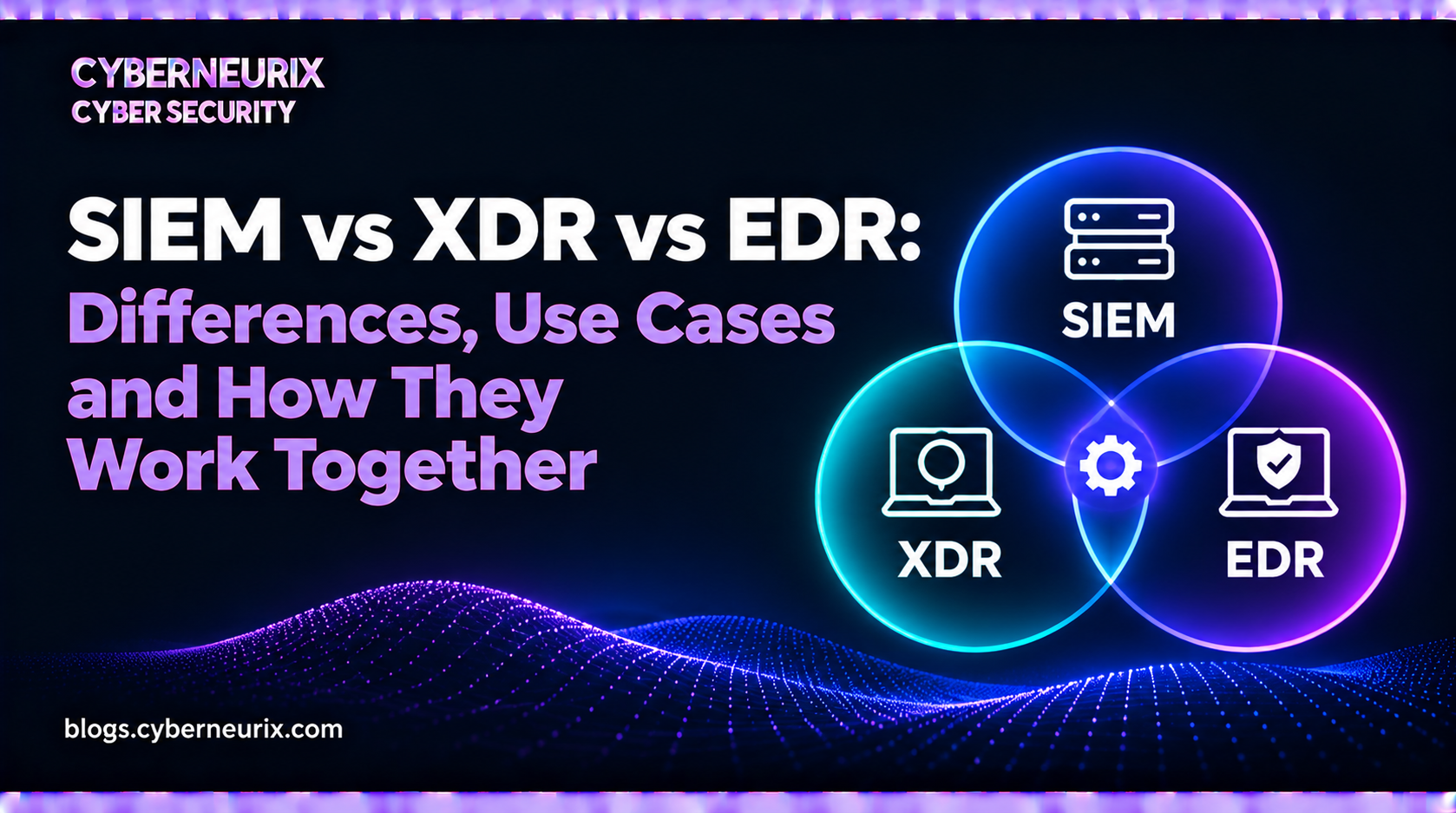
Cutting through this marketing fog requires examining what each technology was engineered to do. SIEM, XDR, and EDR are not direct replacements for one another. When properly understood, they form a complementary, defense-in-depth architecture that provides both surgical host containment and enterprise-wide analytical visibility.
Deep Dive: Architectural Deconstruction — Telemetry, Analytics & Response Boundaries
1. Endpoint Detection & Response (EDR): The Host Micro-Sensor
EDR operates directly inside operating system kernels (Windows, Linux, macOS) via dedicated agents:
- Telemetry Depth: Captures kernel-level events: process creation trees, DLL injections, registry modifications, memory allocations, named pipe communication, and local network socket bindings.
- Detection Model: Behavioral heuristics and memory scanning designed to detect living-off-the-land binaries (LOLBins), ransomware encryption patterns, and privilege escalation.
- Response Authority: Surgical host-level remediation: isolating endpoints from the local network, terminating malicious process trees, quarantining files, and initiating remote live-response forensic shells.
- Architectural Blind Spot: EDR has zero visibility into unmanaged IoT/OT devices, direct cloud API manipulations (e.g., an unauthorized AWS S3 bucket policy modification), network switch compromises, or SaaS identity misuse.
Pushing raw EDR process-creation telemetry directly into a volume-based SIEM without edge filtering can instantly triple log ingestion bills. Organizations should allow EDR/XDR to filter and correlate endpoint events locally, forwarding only high-severity alerts and key process telemetry to the central SIEM.
2. Extended Detection & Response (XDR): The Domain Correlation Hub
XDR represents an evolution in multi-vector threat correlation, natively integrating telemetry across a defined ecosystem:
- Telemetry Scope: Ingests rich telemetry from endpoint agents, identity providers (Okta, Entra ID), email security gateways, and cloud workloads.
- Detection Model: Out-of-the-box cross-domain correlation. It connects a phishing email arrival, an endpoint macro execution, an unusual Kerberos ticket request, and an outbound cloud connection into a single unified incident narrative.
- Response Authority: Orchestrated multi-vector containment: resetting user passwords in the IdP, revoking active cloud session tokens, deleting phishing messages across all enterprise inboxes, and isolating the infected laptop simultaneously.
- Architectural Blind Spot: XDR platforms typically struggle with bespoke enterprise data: proprietary ERP logs, mainframe records, legacy industrial SCADA telemetry, and custom internal application audit trails.
3. Security Information & Event Management (SIEM): The Central Data Lake
SIEM serves as the authoritative, enterprise-wide security repository:
- Telemetry Scope: Universal ingestion. If a device emits text, JSON, or syslog—from core network routers to custom point-of-sale applications—SIEM can parse, index, and retain it.
- Detection Model: Highly flexible, user-defined correlation rules, statistical baseline anomalies, and stateful multi-month behavioral threat hunting.
- Response Authority: Historically passive; modern SIEMs orchestrate external response through dedicated Security Orchestration, Automation, and Response (SOAR) playbooks.
- Compliance & Governance: Built-in reporting frameworks for PCI DSS, HIPAA, SOC 2, and the Indian DPDP Act, supporting multi-year search across hot, warm, and cold storage tiers.
| Dimension | EDR (Endpoint Focus) | XDR (Domain Correlation) | SIEM (Central Data Lake) |
|---|---|---|---|
| Primary Scope | Workstations, servers, container hosts | Pre-integrated vendor security ecosystem | Enterprise-wide IT, OT & business application logs |
| Data Ingestion | Proprietary endpoint kernel driver logs | Endpoint, identity, email, cloud workload telemetry | Universal: Syslog, JSON, CEF, CloudTrail, NetFlow, APIs |
| Detection Focus | Process injection, memory exploits, LOLBins | Multi-stage adversary attack paths across domains | Custom correlation, compliance alerts, long-term hunting |
| Response Actions | Isolate host, kill process, forensic dump | Revoke token, quarantine host, purge email | Orchestrated via external SOAR integrations & APIs |
| Retention Window | Short (7–30 days of raw flight recorder) | Medium (30–90 days of structured telemetry) | Long-term (1–7+ years across hot/cold storage tiers) |
CyberNeurix Unique Angle
"EDR, XDR and SIEM are not a maturity ladder where one automatically replaces the previous tool. A strong endpoint platform does not guarantee visibility into ERP access, databases or cloud control-plane activity."
CyberNeurix recommends designing the security architecture around data boundaries and response authority rather than vendor marketing collateral. Use EDR for surgical host defense, deploy XDR to automate cross-domain incident correlation for Tier-1 analysts, and retain SIEM as the sovereign compliance repository and deep forensic hunting ground.
1. Establish Telemetry Routing Rules: Keep high-volume raw endpoint flight-recorder data inside EDR/XDR; forward only correlated alerts and key process execution events to the SIEM.
2. Designate Response Ownership: Assign immediate automated containment (host isolation, token revocation) to XDR; reserve complex multi-system workflow orchestration for SIEM/SOAR.
3. Audit Blind Spots: Map existing tool coverage against MITRE ATT&CK to verify visibility across unmanaged cloud identities, API gateways, and legacy on-prem infrastructure.
Conclusion
Navigating the enterprise security landscape requires moving past vendor acronym wars to evaluate technical scope, detection logic, and response authority. EDR delivers essential endpoint depth, XDR unifies connected threat domains, and SIEM provides the sovereign enterprise audit record.
Architecting a resilient detection and response capability requires grounding investments in a modern SIEM architecture. By evaluating strategic security tool consolidation in 2026, security leaders build streamlined, high-efficiency security operations centers.
Frequently Asked Questions
Can an XDR platform completely replace an enterprise SIEM?
No. While XDR excels at correlated detection across pre-integrated security domains (endpoint, identity, email, cloud), it lacks the flexible log ingestion, custom compliance retention, and multi-year data analytics of an enterprise SIEM.
What is the primary operational distinction between EDR and XDR?
EDR focuses deeply on host processes, memory, and local filesystem telemetry with host isolation response, whereas XDR correlates EDR telemetry with network, cloud identity, and email signals for cross-domain investigation.
Why is SIEM still mandatory for compliance and regulatory audits?
Regulations (PCI DSS, ISO 27001, DPDP Act) mandate immutable, auditable log retention across firewalls, databases, and business apps that fall outside typical XDR telemetry scope.
How do EDR, XDR, and SIEM work together in a mature SOC?
EDR provides deep host-level telemetry and containment; XDR correlates multi-domain threat activity for rapid incident triage; SIEM aggregates enterprise-wide logs for compliance, long-term hunting, and business risk analytics.
Comparative Reference: SIEM vs XDR vs EDR
| Operational Scenario | EDR Execution | XDR Execution | SIEM / SOAR Execution |
|---|---|---|---|
| Stolen Cloud Admin Token | Blind (no endpoint involved) | Flags unusual IdP login & revokes token | Correlates API audit logs with IAM policy change |
| Ransomware Executable | Detects process injection & isolates PC | Correlates file drop with phishing email source | Triggers enterprise backup snapshot verification |
| Malicious Internal SQL Query | Blind (normal database process) | Blind (unless database audit is integrated) | Detects abnormal data export volume via DB audit log |
| Regulatory Compliance Audit | Inadequate retention & scope | Inadequate retention for external logs | Generates 365-day immutable audit trail report |
Sources: Microsoft SIEM and XDR Incident Response Architecture, Gartner Market Guide for XDR, CyberNeurix Practice
Sources and Further Reading
- Microsoft: EDR vs XDR and the role of SIEM
- Microsoft Learn: SIEM and XDR incident response overview
- Microsoft Sentinel overview
Explore More on CyberNeurix
Next Evolution: The Strategic Roadmap
As we move further into 2026, the intersection of autonomous response and identity-centric architecture will define the winner's circle in cyber defense. Stay tuned for our upcoming deep-dives into LLM-driven threat modeling and quantum-resistant network perimeters.