
Brain Data Privacy in 2026: Statistics, Risks and Regulatory Signals
Key Takeaways
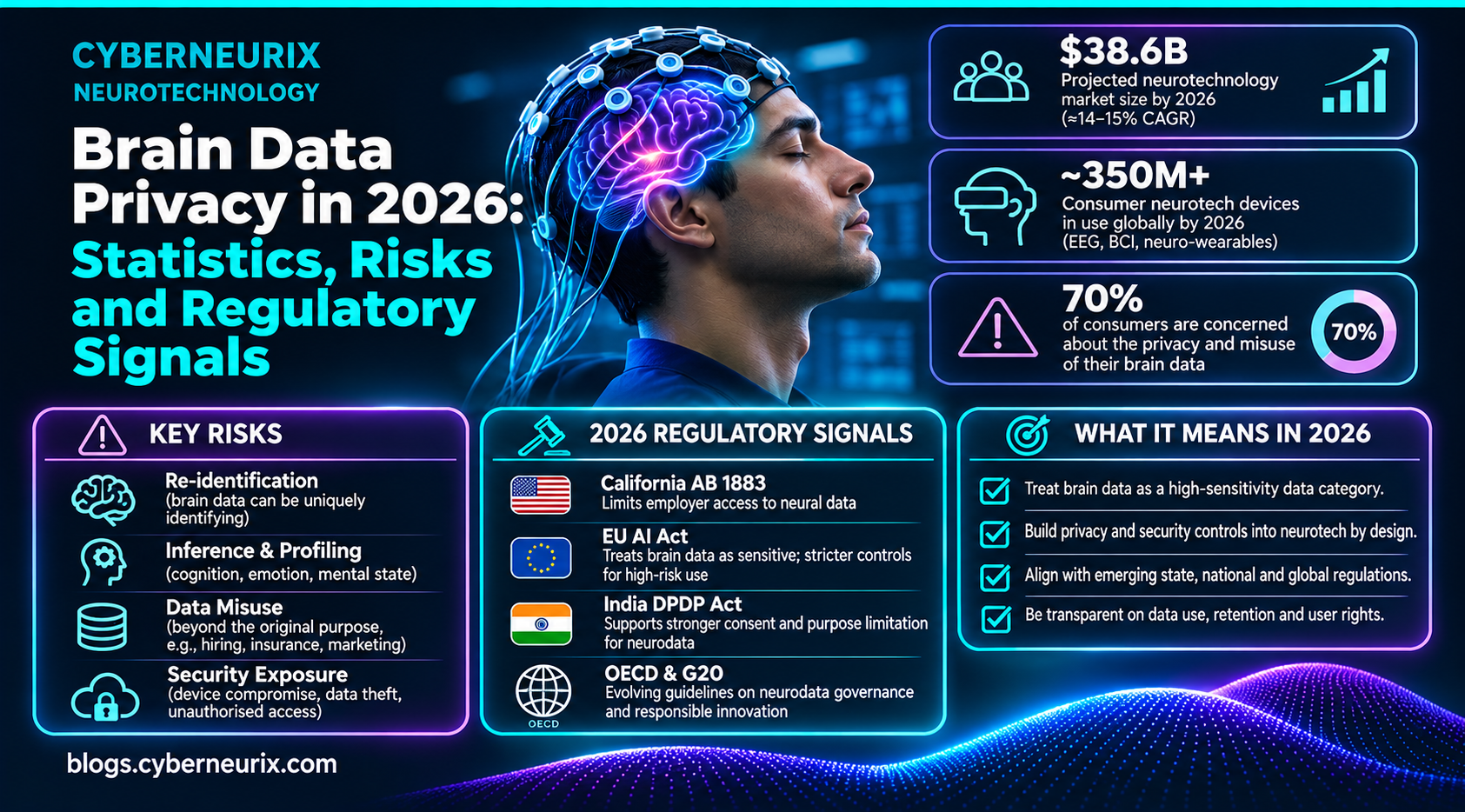
- Brain data privacy has transitioned from bioethics discussions into binding statutory mandates, product architecture constraints, and commercial licensing liabilities.
- Over five U.S. states have enacted laws that severely restrict or condition the commercial sale, licensing, or workplace processing of neural information.
- Data minimization must encompass derived cognitive features, emotional state inferences, and model training weights—not merely raw microvolt recordings.
- De-identification techniques fail to provide absolute protection: neural response patterns act as persistent individual biometric identifiers.
- Organizations collecting neural telemetry must establish cryptographically auditable consent records, strict purpose limitation, and automated local data destruction.
The Uncomfortable Truth About the Ultimate Biometric Vault
When an adversary steals a corporate password, the user changes their credentials. When a credit card number is compromised, the issuing bank cancels the account and issues new plastic. Even compromised biometric fingerprints can be supplemented with hardware tokens. But what happens when an organization leaks three weeks of your continuous electroencephalography (EEG) recordings?
Neural telemetry is the most intimate, sensitive, and unchangeable data an individual will ever generate. It reflects not just deliberate motor actions, but subconscious attention spikes, emotional valence, fatigue, cognitive decline, and involuntary physiological responses to external stimuli. You cannot rotate your brainwave patterns; you cannot revoke your neurological response to a familiar face or a confidential corporate document.
In 2026, the collision between explosive commercial neurotechnology investment and emerging global privacy laws is creating an unprecedented regulatory landscape. Technology leaders must understand the legal signals, empirical statistics, and architectural controls required to govern neural data responsibly.
Deep Dive: Neural Data Governance, State Legislation & Technical Risk Vectors
1. Market Surge Meets the Regulatory Firebreak
The commercial context driving neural data collection is expanding at an extraordinary pace:
- Commercial Market Expansion: The global neurotechnology market is estimated at USD 17.34 billion in 2025 and is projected to reach USD 33.64 billion by 2030 (14.1% CAGR). The specialized BCI segment is forecast to expand from USD 2.36 billion to USD 4.66 billion over the same period.
- The Regulatory Backlash: A landmark legal analysis published by Cooley in September 2026 highlights that five U.S. states—Connecticut, Delaware, Vermont, Colorado, and Montana—have enacted statutes that make commercial neural data licensing unlawful or practically onerous through near-prohibition bans or strict opt-in consent mandates.
- State Patchwork Reality: California's SB 1223 incorporated neural data directly into the California Consumer Privacy Act (CCPA) as sensitive personal information, while Colorado's HB 24-1058 expanded the Colorado Privacy Act to encompass biological data.
Commercial neurotech vendors frequently claim immunity from privacy laws by 'anonymizing' brainwave recordings prior to sale. However, state privacy laws and European regulators are increasingly scrutinizing neural data, recognizing that high-density EEG frequency spectra can be matched against public baselines to re-identify individuals.
2. The Neural Data Risk Hierarchy
To build effective privacy architecture, engineering teams must differentiate between four distinct tiers of neural data:
- Tier 1 — Raw Time-Series Telemetry: Continuous multi-channel voltage recordings captured at 256–1000 Hz. Represents maximum identifiability, medical diagnostic risk, and raw biophysical exposure.
- Tier 2 — Derived Mathematical Features: Spectral band power (Alpha, Beta, Theta), event-related potentials (P300, N400), and spatial covariance matrices. Often processed locally to drive application interfaces.
- Tier 3 — Cognitive & Emotional Inferences: Algorithmic estimates of user attention, stress, emotional state, focus level, or neurological anomalies. Subject to severe workplace surveillance restrictions (e.g., California AB 1883).
- Tier 4 — Model Weights & Training Sets: Neural network parameters trained on aggregated user cohorts. Vulnerable to model inversion attacks where training data can be reconstructed by querying the model.
3. Architecture for Neural Data Minimization & Privacy
Protecting brain data requires moving beyond basic encryption to implement structural architectural isolation:
- On-Device Feature Extraction: Process raw EEG on local embedded ASICs or edge mobile devices. Discard the raw microvolt time-series immediately after computing low-dimensional feature vectors.
- Cryptographic Enclaves & Decoupling: Store extracted cognitive features in dedicated cryptographic vaults completely isolated from user demographic identifiers (names, emails, IP addresses).
- Differential Privacy at Egress: When contributing neural telemetry to academic or commercial research repositories, inject mathematically provable differential privacy noise to prevent record linkage.
| Data Category | Technical Format | Re-identification Risk | Primary Statutory Protections |
|---|---|---|---|
| Raw Microvolt Signals | Continuous multi-channel time-series (EDF, BDF) | Extreme (unique neurological biometric signature) | CCPA (California), CPA (Colorado), GDPR Special Category |
| Extracted Features | Spectral power density, CSP covariance matrices | High (stable individual frequency peaks) | Connecticut Data Privacy Act, Delaware HB 380 |
| Inferred Cognitive States | Attention scores, fatigue index, emotional valence | Moderate to High (when linked to user session) | California AB 1883 (Workplace), Montana GIPA |
| Model Training Artifacts | Trained decoder weights, latent embeddings | Moderate (susceptible to model inversion attacks) | OECD Neurotech Toolkit, UNESCO Ethics Recommendations |
CyberNeurix Unique Angle
"A neurotechnology provider should govern not just the signal it records, but also the features, labels, predictions, and datasets it creates from that signal. Secondary use transforms the risk profile even when initial collection was narrow."
CyberNeurix emphasizes that privacy compliance in neurotechnology cannot be satisfied by updating a website terms-of-service agreement. It demands technical enforcement: ephemeral raw data lifecycles, cryptographic separation between identity and telemetry, and user-controlled consent gates that allow interface actuation while strictly prohibiting secondary monetization.
1. Implement Ephemeral Buffer Policies: Configure acquisition SDKs to purge raw microvolt arrays from memory within 5 seconds of feature extraction.
2. Establish Independent Identity Vaults: Never store user registration records in the same relational database or cloud bucket as neural feature streams.
3. Multi-Tier Consent Controls: Provide separate, granular opt-in toggles for interface control, local performance analytics, and secondary research sharing.
Conclusion
Brain data privacy is not a distant philosophical debate; it is an immediate engineering and legal reality. As commercial neurotechnology expands, organizations that fail to embed rigorous data minimization and cryptographic boundaries into their systems will face severe regulatory penalties and catastrophic trust deficits.
Navigating this complex domain requires mastering the emerging legal principles of neural data privacy laws and brain activity. By implementing a comprehensive neuro data risk framework, organizations build technology that respects human cognitive liberty.
Frequently Asked Questions
What categories of information can be derived from raw EEG brainwave data?
Raw EEG can reveal cognitive workload, emotional arousal, fatigue levels, neurological conditions, visual attention focus, and subconscious responses to specific visual or auditory stimuli.
Which U.S. states have enacted laws specifically governing neural data privacy?
Legal analyses identify California, Colorado, Connecticut, Montana, Delaware, and Vermont as leading states that have enacted statutes categorizing neural data as sensitive personal information.
Can neural telemetry be truly anonymized or de-identified?
De-identification reduces immediate risk, but brainwave frequency spectra and event-related potentials possess unique individual biometric characteristics that carry significant re-identification risks.
What is the difference between raw neural signals and derived cognitive features?
Raw neural signals are continuous microvolt time-series, while derived features are mathematical abstractions (such as alpha band power or classifier task probabilities) extracted for specific applications.
Comparative Reference: Brain Data Privacy in 2026
| Privacy Dimension | Consumer Headset (Focus / Meditation) | Clinical BCI Medical System | Enterprise Workplace Sensor |
|---|---|---|---|
| Governing Law | State Consumer Privacy Acts (CCPA, CPA) | Healthcare Privacy (HIPAA, DISHA, MDR) | Workplace Surveillance Acts (Cal. AB 1883) |
| Consent Model | Standard Click-Through Terms | Informed Clinical Consent Protocol | Specific, Non-Coercive Written Agreement |
| Data Licensing | Frequently monetized via data brokers | Strictly prohibited; retained for clinical care | Explicitly banned without criminal/civil penalty |
| Storage Architecture | Centralized vendor cloud infrastructure | On-premises hospital PACS or encrypted enclave | Local device processing; prohibited central upload |
| User Right to Delete | Mandatory statutory consumer right | Regulated medical record retention overrides | Immediate employee right to demand purge |
Sources: Cooley Neural Data Licensing Report, OECD Neurotechnology Toolkit, CyberNeurix Privacy Practice
Sources and Further Reading
- Cooley: The Law of Neural Data Licensing, 28 September 2026
- The Business Research Company — Neurotechnology Market Report 2026
- The Business Research Company — BCI Market Report 2026
- OECD Neurotechnology Toolkit
Explore More on CyberNeurix
Next Evolution: The Strategic Roadmap
The decentralisation of neural computing is just beginning. Our research pipeline for Q3 2026 focuses on non-invasive cognitive augmentation and the emerging legal frameworks for mental privacy in the workplace.