
Employer EEG Monitoring and Neural Data Laws: What California's AB 1883 Actually Restricts
Key Takeaways
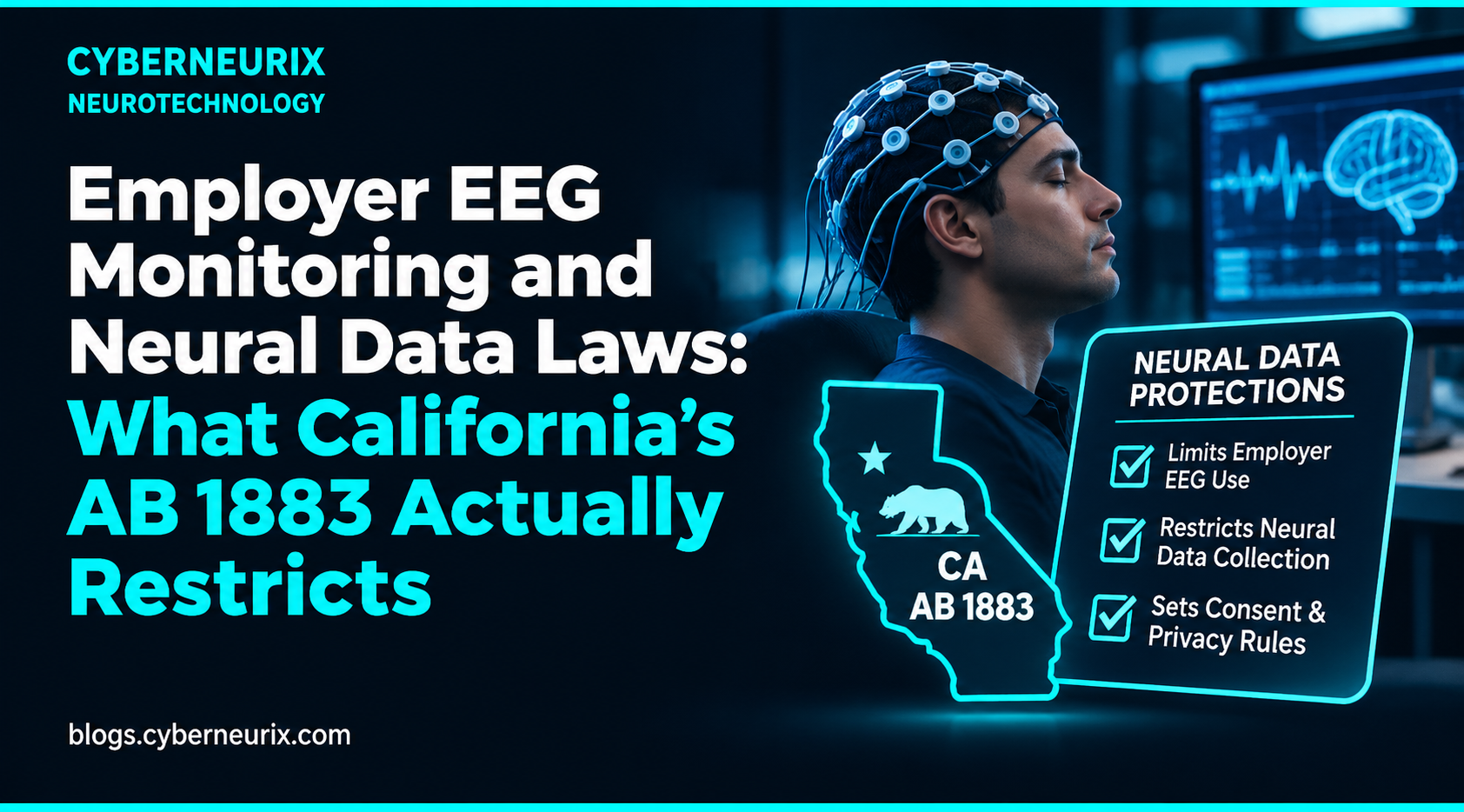
- California AB 1883 (signed September 30, 2026) establishes landmark workplace protections against AI tools collecting neural data or inferring emotional states.
- The statutory effective date is scheduled for January 1, 2027, giving employers and neurotech vendors a defined window to audit workplace monitoring systems.
- The law specifically applies to employees rather than independent contractors, retaining defined exceptions for federal defense and aviation safety requirements.
- Workplace consent cannot be evaluated like consumer click-through terms: inherent employment power imbalances invalidate coercive 'voluntary' monitoring waivers.
- Employers deploying EEG headsets for legitimate industrial fatigue monitoring must isolate safety telemetry from HR performance evaluation and employee records.
The Uncomfortable Truth About the 'Brainwave-Monitored' Workplace
In recent years, enterprise technology vendors have aggressively pitched neurotechnology headsets and smart wearables to corporate HR and safety departments. The marketing narratives sound benign, even benevolent: EEG headbands to monitor heavy machine operator fatigue, earbuds that track knowledge-worker focus to optimize hybrid work schedules, and AI-powered headsets designed to detect workplace stress before burnout occurs.
Behind this wellness branding lies a terrifying reality: the normalization of cognitive surveillance. When an employer monitors an employee's neural oscillations, the boundary between professional output and internal cognitive autonomy dissolves. Can an employee truly refuse to wear a 'focus headband' if declining impacts their promotion prospects, performance ratings, or shift scheduling? Is an employee's emotional state or cognitive workload the legitimate property of their employer?
California has provided a decisive legislative answer. On 30 September 2026, Governor Gavin Newsom signed Assembly Bill 1883 into law as Chapter 853 of the California Code. For technology vendors, enterprise employers, and corporate legal counsel, AB 1883 fundamentally redraws the legal boundaries of workplace neurotechnology.
Deep Dive: Deconstructing California AB 1883 & The Multi-State Workplace Landscape
1. Legislative Anatomy of California AB 1883 (Chapter 853)
Signed into law on 30 September 2026, California AB 1883 establishes a decisive legal boundary:
- Core Restriction: The statute restricts an employer's use of any workplace surveillance tool that utilizes artificial intelligence to collect an employee's neural data or to recognize, infer, or analyze an individual's emotional state.
- Statutory Effective Date: The general provisions of the act are scheduled to take effect on 1 January 2027.
- Covered Population Scope: Final legislative amendments deliberately focused the statute on employees, narrowing earlier draft language that included independent contractors.
- Carve-Outs and Exceptions: The legislature preserved narrow exceptions where monitoring is reasonably necessary to comply with federal mandates relating to commercial aircraft systems development, space exploration, military operations, and national defense contracts.
AB 1883 must not be summarized as a blanket ban on all EEG technology. It specifically targets the convergence of *artificial intelligence workplace surveillance* with *neural data collection* or *emotional state recognition*. Passive research studies and medical diagnostic evaluations operate under different regulatory frameworks.
2. The Multi-State Legal Landscape Beyond California
California is not alone in addressing the workplace neurotechnology challenge:
- Montana Genetic Information Privacy Act (GIPA): Montana's code explicitly restricts the disclosure of a consumer's neurotechnology data to an employer or specified insurers without express, written affirmative consent.
- Delaware (HB 380): Signed in September 2026 and effective January 2027, Delaware's updated consumer privacy framework narrows historical employee exemptions and classifies neural data as sensitive personal data.
- The Power Imbalance Doctrine: Across both European GDPR jurisprudence and emerging American state enforcement, regulators emphasize that employee 'consent' to biometric or neural monitoring is inherently suspect due to the structural power imbalance between employer and employee.
3. Engineering Compliance: Separating Industrial Safety from Surveillance
Organizations that deploy wearable neurotechnology for legitimate physical safety (e.g., commercial truck drivers or mining equipment operators) must implement strict architectural firewalls:
- Zero Emotion / Productivity Tracking: Completely disable all AI algorithmic modules that infer focus, productivity, sentiment, or emotional state.
- Local Edge Processing for Fatigue Alarms: In-cab fatigue alarms (detecting micro-sleep onset) must execute entirely on local edge hardware. Raw brainwaves and fatigue scores must not be uploaded to central HR portals or managerial performance dashboards.
- Total Cryptographic Decoupling: Prohibit the aggregation of neural telemetry with employee personnel records, performance reviews, or termination decisions.
| Jurisdiction | Governing Statute | Workplace Regulatory Mechanism | Key Statutory Exceptions |
|---|---|---|---|
| California | AB 1883 (Chapter 853, 2026) | Restricts AI workplace surveillance collecting neural data or emotional states | Federal aviation safety, military, space & national defense |
| Montana | GIPA (MCA Title 30, Ch. 23) | Prohibits disclosure of neuro data to employers without express written consent | Medical diagnostics under HIPAA / healthcare provider care |
| Delaware | HB 380 (Signed Sept 2026) | Limits employee data exemptions; classifies neural data as sensitive | Permitted clinical healthcare & legal compliance activities |
| European Union | EU AI Act & GDPR Art. 9 | Bans AI emotion recognition in workplaces; neural data as special category | Medical safety equipment with certified clinical oversight |
CyberNeurix Unique Angle
"An employee's 'consent' to neural monitoring may not be meaningful if refusal affects employment, scheduling, promotion or perceived performance. Workplace neurotechnology requires governance beyond a checkbox."
CyberNeurix asserts that workplace neurotechnology demands an ethical and architectural firewall. If an enterprise utilizes neural sensors for physical operator safety, that telemetry must be processed ephemerally on-edge, completely air-gapped from managerial performance databases, and legally barred from HR employment decisions. The human mind must remain sovereign.
1. Immediate Tool Inventory: Audit all enterprise wearables, smart headsets, and video monitoring software for AI modules that infer emotional valence or collect EEG.
2. Terminate Productivity Brainwave Pilots: Immediately cancel any workplace pilot programs measuring worker focus, attention, or stress via neural sensors.
3. Air-Gap Fatigue Safety Telemetry: If deploying EEG for industrial vehicle micro-sleep detection, configure systems to trigger local audio alarms without uploading records to central HR.
Conclusion
Workplace neurotechnology has entered a strict, binding statutory environment. California AB 1883 and emerging state laws make it clear that treating worker cognitive states as corporate operational data creates severe legal and ethical liabilities.
Safeguarding employee cognitive privacy requires conducting structured neural data privacy incident analysis. By proactively confronting the critical AI and neuroethics technology questions of 2026, enterprise leaders build workplaces founded on trust, safety, and respect for human agency.
Frequently Asked Questions
What specifically does California AB 1883 restrict in the workplace?
AB 1883 restricts an employer's use of workplace surveillance tools that utilize artificial intelligence to collect neural data or recognize, infer, or analyze an employee's emotional state, effective 1 January 2027.
Are there statutory exceptions to California AB 1883?
Yes. The law carves out specific exceptions for uses reasonably necessary to meet federal requirements relating to commercial aircraft development, national security, defense, space exploration, and military operations.
Can an employer bypass neural surveillance laws by having employees sign a consent waiver?
Under AB 1883 and emerging employment jurisprudence, consent cannot be freely given when conditioned on employment, scheduling, or compensation, rendering blanket employer waivers legally unenforceable.
How does Montana's Genetic Information Privacy Act regulate employee neurotechnology?
Montana's statute explicitly prohibits the disclosure of a consumer's neurotechnology data to an employer or health/life insurer without express, written affirmative consent.
Comparative Reference: Employer EEG Monitoring and Neural Data Laws
| Deployment Scenario | Permissible under Cal. AB 1883? | Permissible under Montana GIPA? | Required Architectural Control |
|---|---|---|---|
| Office Focus / Productivity Tracking | Explicitly Unlawful (AI surveillance) | Unlawful without independent written consent | Decommission pilot; purge stored cognitive data |
| Emotion AI Sentiment Analysis | Explicitly Unlawful (emotional state inference) | Severely restricted under sensitive data rules | Strip emotion-inference algorithms from video/audio |
| Commercial Aviation Fatigue Safety | Permitted under narrow Federal Exemption | Permitted with explicit regulatory consent | Comply with FAA / federal safety mandates |
| Industrial Local Micro-Sleep Alarms | Permitted if non-AI or edge-isolated | Permitted if unlinked from employer HR files | Ephemeral edge processing; zero central cloud export |
Sources: California Legislature AB 1883 Bill Text, Governor's Signing Announcement, Montana Code Annotated, CyberNeurix Analysis
Sources and Further Reading
- California AB 1883 — chaptered status and legislative summary
- Governor of California — 30 September 2026 signing announcement
- Montana Code — neurotechnology data disclosure provisions
- Cooley — state neural-data licensing landscape
- Delaware — 2026 consumer privacy legislation announcement
Explore More on CyberNeurix
Next Evolution: The Strategic Roadmap
The decentralisation of neural computing is just beginning. Our research pipeline for Q3 2026 focuses on non-invasive cognitive augmentation and the emerging legal frameworks for mental privacy in the workplace.