
Neural Data Privacy Laws in 2026: The State Patchwork Neurotech Companies Must Map
Key Takeaways
- The outdated headline that 'neural data is regulated in four states' is obsolete: the legal landscape has evolved into a complex, multi-jurisdiction statutory patchwork.
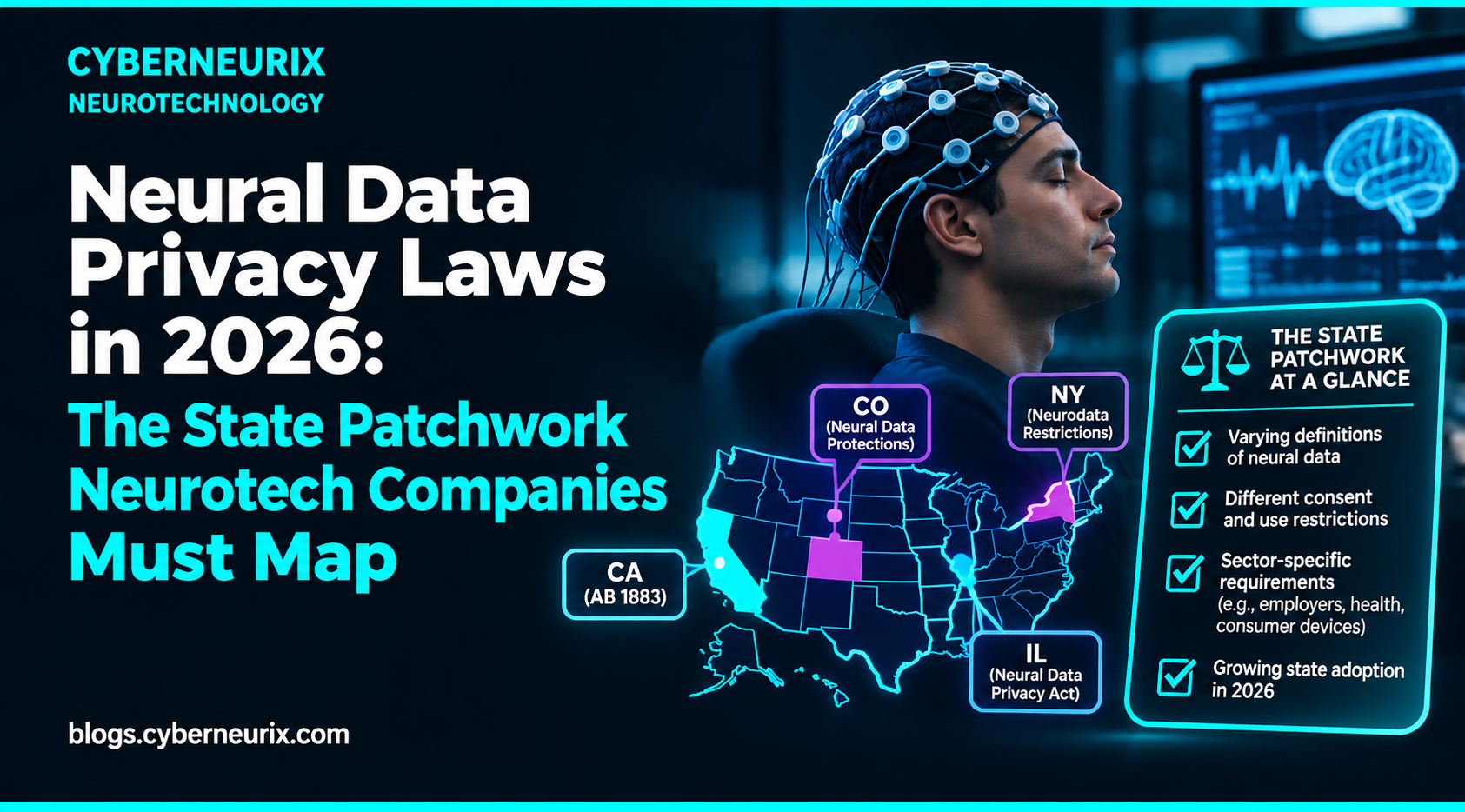
- California, Colorado, Connecticut, Montana, Delaware, and Vermont have each enacted distinct legal mechanisms with specific effective dates stretching from 2026 to 2028.
- Statutory mechanisms diverge: California amends consumer privacy definitions, Colorado targets biological data, and Montana restricts disclosure to employers and insurers.
- Commercial neural data licensing faces near-prohibitive statutory hurdles across at least five state jurisdictions unless express opt-in consent is obtained.
- Compliance requires an individualized data-and-jurisdiction map: consumer, research, medical, and employment contexts carry fundamentally different legal rules.
The Uncomfortable Truth About the Neural Privacy Patchwork
Until recently, commercial neurotechnology companies operated in an almost total regulatory vacuum. Outside of clinical medical devices regulated by the FDA, consumer brain-computer interface headsets, meditation wearables, and focus-tracking headbands gathered, stored, and monetized neural telemetry with minimal legal oversight. Terms of service were drafted loosely, and data monetization strategies were modeled after consumer adtech.
In 2026, that regulatory vacuum has violently imploded. State legislatures across the United States have recognized that brainwave data represents an unprecedented threat to mental privacy and cognitive liberty. However, in the absence of a comprehensive federal privacy statute, individual states have drafted disparate, overlapping, and occasionally conflicting neural data statutes.
For product managers, compliance counsel, and cybersecurity architects at neurotech firms, treating neural privacy as a single checkbox is a catastrophic error. Operating across the United States requires mapping the exact statutory mechanisms, definitions, and enforcement dates across every state boundary.
Deep Dive: Mapping the State-by-State Legislative Patchwork in 2026
1. State-by-State Statutory Breakdown
The American neural data landscape is defined by distinct legislative approaches:
- California (SB 1223): Amended the California Consumer Privacy Act (CCPA) to explicitly include 'neural data' within the definition of sensitive personal information. Neural data is defined as information generated by the measurement of the activity of an individual's central or peripheral nervous system that can be processed by or with the assistance of neurotechnology. Crucially, it excludes data inferred from non-neural sources.
- Colorado (HB 24-1058): A pioneer in neural regulation, Colorado expanded the Colorado Privacy Act to include 'biological data'—expressly defining neural data as sensitive personal data. Controllers are legally barred from processing consumer neural telemetry without obtaining explicit, freely given opt-in consent.
- Connecticut (CTDPA Amendments): Updated the Connecticut Data Privacy Act to include neural data within its sensitive personal data framework, with enforcement taking full statutory effect on 1 July 2026.
- Montana (GIPA Amendments): Amended its Genetic Information Privacy Act to extend robust protections to 'neurotechnology data.' Montana law introduces unique restrictions, explicitly prohibiting disclosure of a consumer's neuro data to an employer or health/life insurer without express written consent.
- Delaware (HB 380): Signed into law on 2 September 2026, adding neural data to protected sensitive consumer categories requiring mandatory opt-in consent, with provisions taking effect on 1 January 2027.
- Vermont (S.71 / Act 145): Enacted on 16 June 2026, the Vermont Data Privacy Act incorporates neural telemetry protections, with statutory enforcement scheduled for 1 January 2028.
Many neurotech companies assume that complying with general state consumer privacy acts (such as CCPA) protects them in workplace scenarios. However, many consumer privacy statutes exempt B2B and employment records, while specific workplace laws (such as California AB 1883) carry strict civil penalties for employee neural monitoring.
2. The Commercial Licensing Firebreak
A critical legal analysis published by Cooley in September 2026 examined how these emerging laws impact the commercial monetization of neural data:
- The Licensing Barrier: Five states—Connecticut, Delaware, Vermont, Colorado, and Montana—have created legal frameworks that make commercial neural data licensing unlawful or practically impossible through outright bans or strict opt-in hurdles.
- Data Broker Scrutiny: State data-broker registration registries (California, Vermont, Texas) increasingly require entities aggregating and licensing biological telemetry to register publicly, disclose data collection methodologies, and provide universal opt-out mechanisms.
3. Engineering a Multi-Jurisdiction Compliance Architecture
To navigate this regulatory patchwork, neurotechnology engineering teams must implement technical controls:
- Residency-Aware Ingestion Routing: Configure cloud ingestion APIs to identify the geographic residency of the user and apply jurisdiction-specific consent verification before telemetry is written to storage.
- Purpose-Bound Cryptographic Enclaves: Isolate data collected for primary interface actuation from secondary research pools, ensuring that revoking secondary research consent immediately deletes analytical features without bricking the device.
- Immutable Consent Ledgering: Maintain cryptographically verifiable audit logs documenting the exact date, time, statutory version, and scope of user consent.
| State | Enacted Legislation | Statutory Mechanism | Effective Date | Mandatory Compliance Requirement |
|---|---|---|---|---|
| California | SB 1223 (Chaptered 2024) | Amends CCPA sensitive personal info | Active | Right to limit use; purpose limitation; deletion rights |
| Colorado | HB 24-1058 (Chaptered 2024) | Expands CPA biological sensitive data | Active | Mandatory opt-in consent before processing or sale |
| Connecticut | CTDPA Amendments | Expands sensitive data definitions | 1 July 2026 | Opt-in consent for sensitive data; data protection assessment |
| Montana | GIPA Amendments | Extends GIPA to neurotechnology data | Active | Prohibits disclosure to employers/insurers without consent |
| Delaware | HB 380 (Signed Sept 2026) | Adds neural data to sensitive categories | 1 January 2027 | Opt-in consent; strict commercial licensing limits |
| Vermont | S.71 / Act 145 (June 2026) | Vermont Data Privacy Act sensitive data | 1 January 2028 | Opt-in consent; data broker registry compliance |
CyberNeurix Unique Angle
"Neurotech companies need a data-and-jurisdiction map, not a single 'neural data compliant' badge. The same dataset may be subject to different rules depending on consumer residence, controller role, and whether data is sold or processed."
CyberNeurix asserts that geographic data compliance in neurotechnology must be enforced in code, not merely on paper. When an enterprise operates connected neural interfaces across California, Colorado, Delaware, and international markets, software architecture must programmatically enforce local consent rules at the API gateway layer before a single microvolt packet is stored.
1. Implement Ingest Consent Gates: Block device API communication if the user profile lacks verified, unrevoked opt-in consent matching their state jurisdiction.
2. Terminate Third-Party Licensing Feeds: Audit commercial partnerships and immediately sever telemetry sharing with unregulated data brokers in five key states.
3. Prepare for 2027/2028 Milestones: Audit Delaware (Jan 2027) and Vermont (Jan 2028) statutory requirements to ensure product roadmaps remain compliant.
Conclusion
The era of unregulated commercial neurotechnology is officially over. The emerging patchwork across California, Colorado, Connecticut, Montana, Delaware, and Vermont signals a permanent global shift toward cognitive privacy rights that engineering teams must accommodate from inception.
Staying ahead of biological data regulation requires mastering neural data privacy laws and brain activity. By aligning enterprise governance with international frameworks and the DPDP Act and cybersecurity breach readiness, global innovators build sustainable, legally compliant neurotechnology platforms.
Frequently Asked Questions
How does California regulate neural data under SB 1223?
California SB 1223 incorporated neural data into the CCPA's definition of sensitive personal information, defining it around measurements of central or peripheral nervous system activity generated by neurotechnological devices.
What makes Colorado's HB 24-1058 unique in neural privacy regulation?
Colorado HB 24-1058 expanded the Colorado Privacy Act to classify biological data—expressly including neural data generated by brain measurement—as sensitive data requiring opt-in consent before processing.
Which states have established restrictions on commercial neural data licensing?
Cooley's September 2026 analysis identifies Connecticut, Delaware, Vermont, Colorado, and Montana as states where statutory definitions or consent requirements severely condition or restrict commercial neural data licensing.
Do state neural privacy laws protect employees against workplace EEG surveillance?
Consumer privacy laws often exclude employee data. However, dedicated workplace surveillance laws like California AB 1883 and Montana GIPA specifically regulate employee neural monitoring.
Comparative Reference: Neural Data Privacy Laws in 2026
| Statutory Dimension | General Consumer Privacy (e.g. CCPA) | Neural-Specific Privacy (e.g. CO HB 24-1058) | Workplace Surveillance (e.g. CA AB 1883) |
|---|---|---|---|
| Covered Population | General state residents as consumers | General consumers generating neural data | Employees and job applicants specifically |
| Consent Standard | Notice & Opt-Out (standard data) | Explicit, Affirmative Opt-In (sensitive) | Explicit consent; strict necessity exceptions |
| Commercial Licensing | Permitted with opt-out mechanisms | Severely conditioned / practically restricted | Explicitly banned for cognitive surveillance |
| Private Right of Action | Limited to data breaches (CCPA) | Typically limited to Attorney General / AG Enforce | Civil actions with statutory damages & fines |
Sources: Cooley Neural Data Licensing Analysis, California Legislative Information, Colorado General Assembly, CyberNeurix Practice
Sources and Further Reading
- Cooley: Neural data licensing state-law landscape, 28 September 2026
- California SB 1223 analysis
- Colorado HB 24-1058
- Connecticut Attorney General — Connecticut Data Privacy Act
- Montana Code — neurotechnology data definitions
- Delaware — HB 380
- Vermont — S.71 / Act 145 status and effective dates
Explore More on CyberNeurix
Next Evolution: The Strategic Roadmap
The decentralisation of neural computing is just beginning. Our research pipeline for Q3 2026 focuses on non-invasive cognitive augmentation and the emerging legal frameworks for mental privacy in the workplace.